derivative-update code should now be pretty much stabilized.
docker integration code should now be pretty much stabilized.
(The issue described in Docker Container that builds Whonix Images - #156 by arraybolt3 remains unresolved.)
TODO items were added to docker integration code in case anyone wishes to contribute.
Hi everybody!
I’ve made a few minor changes to simplify/optimize containerization using buildah and make images compatible with other engines. Thought some of this might be useful.
Hope you’re doing well!
1 Like
Hmm, we’ve started relying rather heavily on the Docker-based build mechanism in our CI pipelines (thank you for making that possible, by the way). We could probably port the CI over to this, but I’m not sure it’s a good investment of time right this moment since we have a lot of other features being worked on at the moment. Still, this initially looks pretty cool 
2 Likes
Hey man, no worries!
I needed an implementation for podman and thought I’d share this with you guys, in case you were interested.
These updates are more of a byproduct, my original goal is completely rootless derivative-maker. I think I’ll have it done by September and will share once completed.
Forget the PR, but In case you have some spare time, PID1 systemd can now be implemented with a simple CMD calling /sbin/init and using exec to enter the container. That completely obsoletes our original entrypoint.sh + service workaround.
If you need some hands, I’d be happy to help btw. This time with a bit more experience. 
Hope you and Patrick are doing ok, you’re still going strong.
2 Likes
Thanks! Rootless derivative-maker sounds very useful, so please keep us posted on how that goes!
2 Likes
Sure thing! What are you guys working on right now, regarding derivative-maker?
The most notable things so far are:
- removing live-build from the ISO build mechanism so that the ISO builds use the same build infrastructure as the other images, then are converted to ISOs by a relatively small script at the end
- preliminary reproducible build support
- lots of code refactoring, hardening, and style fix-ups in general
(Note that this is slightly off-topic for this thread, we might want to make a new thread for this topic.)
1 Like
removing live-build from the ISO build mechanism so that the ISO builds use the same build infrastructure as the other images, then are converted to ISOs by a relatively small script at the end
I’ve just replaced live-build with debos for all my live ISO builds. It’s basically rootless debootstrap with YAML driven build actions. Extremely powerful and intuitive for reproducibility. Not sure how far you’ve gotten already with the refactor, but I swear by it now.
(Note that this is slightly off-topic for this thread, we might want to make a new thread for this topic.)
Yes sry, if you like let’s open a topic.
2 Likes
@Patrick I added a full (working) derivative-maker Actions runner compatible with Free Tier CI. ~40min to build Kicksecure-LXQT requiring ~45GB. It uses a qemu vm and my derivative-maker-oci implementation. It’s functioncal, but after cleaning up the code, menu, release manifest, adding Matrix Builds (GW/WS) and cron jobs it could be nice.
If you like I can handle CI & Containerization, to free you up for more important things. Quite familiar with both at this point. If you have some comments or suggestions, please let me know.
Run:
Release:
Raw Log:
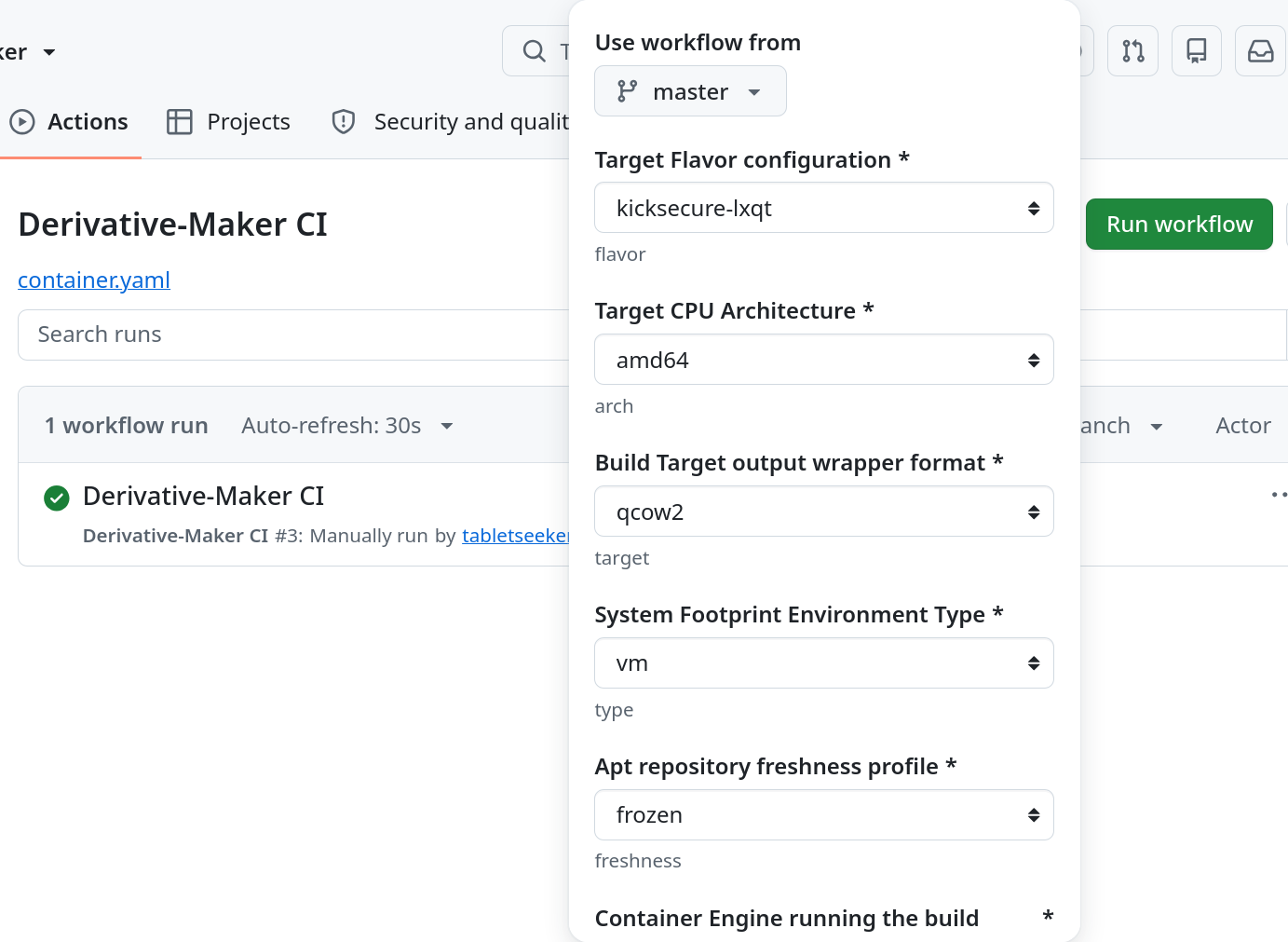
I’m a bit afraid you may be doing duplicate work. I mentioned the .github directory in derivative-maker earlier; we’re already using GitHub Actions’ free tier for our CI systems. It’s possible you’re using a not-yet-up-to-date version of derivative-maker? Or am I misunderstanding what you’re doing?
1 Like
I’m a bit afraid you may be doing duplicate work. I mentioned the
.githubdirectory in derivative-maker earlier; we’re already using GitHub Actions’ free tier for our CI systems.
Hey there! Yes, but isn’t yours just dry-running and stripped down validation testing, from the looks of it?
My runner (successfully) executes full derivative-maker and uploads production releases, plug & play.
Speed-wise it’s also doing quite well, considering. 
Maybe I missed something, I’ll check again what you referenced yesterday.
1 Like
@arraybolt3 I had another look. Your ai_assisted workflows are fine for limited testing and validation, but my accelerated qemu runner achieves bare-metal execution and native CI production releases in a very reasonable time frame. ( ~40 - 48min ). I also think that the OCI solution is superior to your/our outdated docker implementation. Can those even pass a full run without a hypervisor?
Both could be used for testing & production, but moving away from docker is likely for the best in any case.
Switching to podman in the CI actually has multiple benefits and I’m getting close with full rootless operation of derivative-maker now. If @Patrick gives the green light, I’ll polish the code, clone some actual tags (only used my master so far in testing) and finalize for a merge.
I can walk you through the workflow in the meantime. I’m sure this would have to be hardened to death, but when I researched possible solutions this seemed like the most natural, least hacky one.
Here are my scripts and yaml. The magic happens in build-guest.sh. I settled on using SSH, `-netdev user hostfwd` and Heredoc for injection. It also works with a shell, but tty constraints make it brittle. Basically, it’s just a 127.0.0.1 tunnel.
One thing we’ll have to add is a safeguard that deletes old releases at a certain point, so the Free Tier limit is not exceeded. I ran into this with one of my repos, but it’s fine and can easily be automated in the yaml.
Was like this but it’s now full builds or downloads (separate lanes) on a separate server with full graphical testing, systemcheck, and whatnot. More here:
1 Like
Hi, Patrick!
OK, so it is self-hosted then. (I’m assuming deliberately, for security reasons).
That explains how you’re building it, but where is the pipeline that actually produces artifacts? The yamls in .github/workflows are not doing this?
That boot screenshot verification is cool af btw. 
Yeah, in that case you’re probably avoiding Actions for a reason, but I’m still kinda proud of achieving this in Free Tier. 
Yes.
No. GitHub actions with limited time per run (1 hour?) and limited time per month wasn’t suitable. Also one typically doesn’t have SSH access to GitHub CI servers (maybe reverse SSH could be added which may or may not violate GitHub terms of service) for the purpose of debugging failed builds/tests. So GitHub free CI didn’t seem suitable for automated image builds and automated tests. Those take too much time.
On the server only, and not uploaded anywhere, except for text/screenshots on the website I shared.
There’s no automatic trigger yet as in new tag/commit on GitHub event → try to build. Build+tests is manually dispatched. I am not worried about automatic dispatching yet, rather increasing test coverage and fixing bugs such as empty screenshots.
1 Like
Yes.
I should’ve figured. Thought I was gonna walk in here like Conor McGregor with this.
It’s been a while, hope everything is fine. 
GitHub actions with limited time per run (1 hour?) and limited time per month wasn’t suitable.
Only private appliances are metered now. Public repositories get unlimited minutes and executions. Only the general limitations are in effect, i.e. auto termination after 6h, max 256 matrix jobs and 20 concurrent runs, which nobody needs anyway.
I created a test repo for this first beforehand and must’ve done at least 100 runs within 48 hours. They even start caching packages at certain point, automatically. You can set it up manually, though. (I think)
Also one typically doesn’t have SSH access to GitHub CI servers (maybe reverse SSH could be added which may or may not violate GitHub terms of service) for the purpose of debugging failed builds/tests.
No idea. The way I use it here is to communicate with the qemu guest’s localhost directly, forwarding/injecting .github/scripts via Heredoc. So it’s contained, but I wonder if they actually allow server access?
Those take too much time.
You’re `dm-release-test` node is probably beefy as hell, but by how much are you beating my ~40 min?
Locally, on a 12 yo overlocked Quad Core, I can still build under 20 minutes.
There’s no automatic trigger yet as in new tag/commit on GitHub event → try to build. Build+tests is manually dispatched. I am not worried about automatic dispatching yet, rather increasing test coverage and fixing bugs such as empty screenshots.
Is your Claude implementation running locally as well, or via Github’s paid plan?
This whole ai_assisted monstrosity seems sophisticated and complex af. Did you build all this on your own?
If I remember correctly you weren’t a big fan of AI. None of the OG’s were, but it’s undeniable at this point. The initial llama draft for my CI thing was close, only needed minor fixes.
Anyway, if you have absolutely no need for this, I’ll just use it for myself and leave it as is. Otherwise, I’d be happy to clean it up and finalize options, manifest, matrix etc.
Patrick did, yes. It is very involved, but it lets us take full advantage of AI’s ability to find vulnerabilities without giving it the ability to inject new ones of its own accord.
AI has gotten a lot better at coding and review tasks in recent times, and while there are still a lot of things that make it very non-ideal (closed-source, proprietary, extraordinarily resource-intensive to train and use thus all-but-mandating the use of cloud services, models sometimes get geoblocked for political reasons, hallucinations, etc.), in the end it is able to find bugs and vulnerabilities and it is able to very quickly prototype complex features to the point where a human can review it, fix its work, and get the feature created much quicker than previously. We’ll be no worse off if its providers take it away or stop providing it than we would be if we never used it, so while we have access to it, we may as well get everything we can from it to further Freedom Software, security, and anonymity. At the same time, we don’t trust it since it’s closed-source, proprietary, and able to act maliciously by design, so we treat it as a third-party contributor with an unusually high likelihood of malicious behavior.
1 Like
I guess, but it seemed like you didn’t even realize upstream CI doesn’t build releases when you were seemingly confused before. Did you write those yamls?
while there are still a lot of things that make it very non-ideal (closed-source, proprietary
That’s a choice. Kimi, Llama and Qwen are scoring on par with the big dogs now in SWE-bench.
Co-Pilot Claude is disgustingly powerful though, gotta admit it.
resource-intensive to train
What are you using to train the model? Thought this was regular Claude Sonnet on a Github plan.
We’ll be no worse off if its providers take it away or stop providing it than we would be if we never used it, so while we have access to it, we may as well get everything we can from it to further Freedom Software, security, and anonymity.
Noticing that you like to use “we” and “us” a lot. I see regular activity from Claude and Patrick on git, but what have you been focusing on lately?
At the same time, we don’t trust it since it’s closed-source, so we treat it as a third-party contributor with an unusually high likelihood of malicious behavior
I’m assuming the reason for this is convenience. Setting up a local model costs time and money, that’s understandable.
Specifically training an LLM on derivative-maker code, build logs, configs, metadata etc. with those new attention mechanisms could probably fill a wiki of its own, but might not yield significantly better results than corporate solutions. Probably better to avoid the headache, but I do see a lot of security people using private, local models for the reasons you mentioned.
./help-steps/dm-build-official
- VirtualBox Whonix-Gateway CLI
- VirtualBox Whonix-Gateway LXQt
- VirtualBox Whonix-Workstation CLI
- VirtualBox Whonix-Workstation LXQt
- VirtualBox Kicksecure CLI
- VirtualBox Kicksecure LXQt
- Double that for KVM images. (Re-uses raw image but still takes extra time.)
- Kicksecure ISO LXQt
Then do various test lanes. Boot into different boot modes, ISO calamares installed, and whatnot.
No GitHub paid plan needed.
Claude and countless hours of prompting.
Citation required. Dunno what you mean.
Artificial Intelligence (AI)? Kicksecure Policy on Artificial Intelligence (AI)?
I consider those still up-to-date, neutral, and factual, not any “fan” or “dislike” status.
GitHub YML files are largely AI generated, run on org-ai-assisted GitHub organisation only.
At this time, thanks to a dedicated (single-purpose) untrusted test server, use of GitHub CI is largely optional. It can catch some undeclared dependencies or run test which might cause instability on the server (such as unit tests running mount/unmount).
I guess that was meant generally.
No AI training / fine-tuning at this point. (That would be useful in theory, so automatic coding style fixer / linter wouldn’t be required and no tokens/time was wasted on coding style fixes.)